Making laser marking safe, smart and productive
Laser marking has become an increasingly valuable solution for manufacturers looking to improve product identification, traceability and brand protection. From batch numbers and expiry dates to serial numbers, logos and GS1 2D codes, laser technology can create permanent, high-quality marks without the need for inks, labels or other marking consumables.
But while the benefits are clear, laser marking safety must never be an afterthought.
Industrial lasers can present significant risks if they are not properly enclosed, controlled and maintained. The good news is that, with the right equipment, safeguards and working practices, manufacturers can integrate laser marking into their production lines while protecting operators and maintaining efficient operations.
At REA UK, we believe that understanding laser safety is an essential part of specifying the right marking solution. Here’s what every production, engineering and health and safety team should know.
Understanding laser classification: What does Class 1 really mean?
One of the most important starting points is understanding laser classification.
Under BS EN / IEC 60825-1, laser products are classified according to the accessible laser radiation they emit. The classification of the complete machine in its intended operating configuration is particularly important when selecting an industrial marking system.
Here is a simplified overview of the main classes:
- Class 1: Designed to be safe under reasonably foreseeable conditions of use. This is a common target for fully enclosed industrial laser marking stations.
- Class 1M: Generally safe for unaided viewing, but optical instruments can increase the risk.
- Class 2 and Class 2M: Relate to visible, low-power laser radiation and are not the typical classification for industrial marking beams.
- Class 3R and Class 3B: Can present hazards from direct viewing and require appropriate controls.
- Class 4: Can cause serious eye and skin injuries. Reflections, fire hazards and process fumes may also need to be addressed.
Many industrial fibre and CO₂ marking lasers are Class 4 sources when operated with an accessible beam. However, when incorporated into a suitably designed and safeguarded enclosure, the complete marking machine can achieve Class 1 classification for normal operation.
The crucial distinction? A Class 1 machine can contain a Class 4 laser source.
Class 1 does not mean there is no hazardous radiation inside the machine. It means the system is designed to prevent hazardous radiation from being accessible during intended use and reasonably foreseeable operating conditions.
Always check the complete machine’s classification and labelling rather than relying solely on the specification of the laser module.
Protective enclosures and interlocks: Your first line of defence
Effective laser safety begins with engineering controls, not personal protective equipment alone.
A well-designed industrial laser marking station should incorporate safeguards that prevent operators from being exposed to hazardous laser radiation during normal production.
These may include:
Protective enclosures: Light-tight or otherwise appropriately safeguarded housings contain the laser beam and restrict access to hazardous radiation.
Interlocked access doors: Safety interlocks are designed to stop laser emission when an access door is opened, subject to the system’s safety design.
Laser safety windows: Any viewing window must be suitable for the laser’s wavelength and optical density (OD), as well as the relevant power and exposure conditions.
Emergency stops and clear labelling: Operators need clearly identified controls, appropriate warnings and a straightforward way to respond to an emergency.
Controlled production and service modes: Maintenance and alignment activities can introduce different risks from normal production. These modes must be properly controlled and documented.
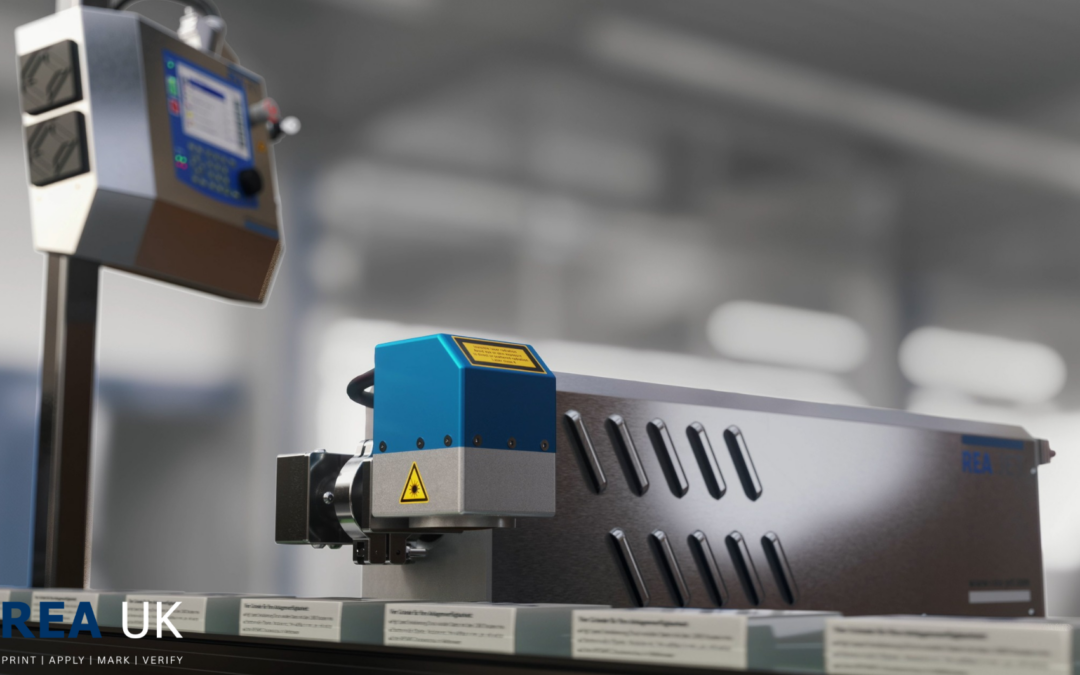
For production environments, REA LASER marking stations follow this established approach: integrating the laser into a safeguarded system so that operators can work productively without exposure to an open laser beam during normal operation.
For online applications, additional measures such as guarding tunnels, beam dumps and light curtains may also form part of the overall safety design, depending on the installation.
Laser safety goes beyond the beam
Laser classification is essential, but it does not cover every hazard associated with the marking process.
The material being marked, the depth of the mark and the surrounding production environment can all influence the risk assessment.
Fumes, particles and laser-generated air contaminants
Laser marking can release fumes and particles when interacting with plastics, coatings and metals. These are often referred to as laser-generated air contaminants (LGAC).
The appropriate extraction system must be selected for the specific materials and process conditions. A generic fan is not necessarily sufficient.
Consider the substrate, marking parameters and whether the application involves surface marking or deeper engraving. More intensive ablation can increase heat and the amount of material released, potentially requiring additional extraction and fire precautions.
Reflections from shiny surfaces
Polished metals and glossy films can reflect laser radiation. Depending on the laser and application, these reflections may create additional hazards if they are not adequately controlled.
The system design must account for the material, beam path and potential reflections.
Fire and heat
Laser marking introduces concentrated energy into a small area. Paper, cardboard, films and dusty surroundings may present ignition or smouldering risks.
Appropriate safeguards should reflect the materials being processed, the marking parameters and the conditions on the production line.
Maintenance and servicing
A system that is safe during normal production may present different hazards during maintenance or alignment.
Opening an enclosure, accessing the beam path or entering a service mode can change the level of risk significantly. These activities should only be undertaken by appropriately authorised and trained personnel following the manufacturer’s procedures and the site’s risk assessment.
The takeaway: A safe laser marking process considers optical radiation, fumes, reflections, fire and maintenance — not simply the laser class.
Building a practical laser safety checklist
When specifying or reviewing an industrial laser marking installation, it helps to take a structured approach.
Engineering controls
- Confirm that the complete machine is appropriately classified for its intended use.
- Check that protective enclosures and access interlocks are suitable for the application.
- Verify that laser safety windows are correctly specified for the wavelength and exposure conditions.
- Ensure the beam path is contained and that guarding is appropriate for the production layout.
- Select extraction equipment to suit the materials and marking process.
- Review emergency stops, warning labels and service-mode controls.
Procedures and training
- Establish documented procedures for production, changeovers, cleaning and maintenance.
- Train operators to understand the safeguards, warnings and correct operating procedures.
- Ensure interlocks are never bypassed without the appropriate authorisation and controlled procedures.
- Maintain safety labels, protective seals and other relevant safeguards.
- Make sure maintenance and service activities are covered by appropriate risk assessments and procedures.
Personal protective equipment
Personal protective equipment (PPE) is an important part of the safety strategy where the risk assessment identifies a need, particularly during authorised service work or operations involving an open enclosure.
Laser protective eyewear must be suitable for the relevant wavelength and optical density. Ordinary sunglasses are not a substitute.
Skin protection and respiratory protective equipment (RPE) should also be considered where required by the risk assessment and applicable procedures. RPE should not be treated as a replacement for effective engineering controls and appropriate fume extraction.
The guiding principle is simple: prioritise engineering controls, support them with clear procedures and training, and use PPE where appropriate.
Choosing a laser marking system? Ask these six questions
Laser safety should be part of the purchasing conversation from the beginning — alongside marking quality, speed and integration.
Before committing to a system, ask your supplier:
- What is the classification of the complete machine?
For an enclosed production application, can the system operate as Class 1 under the intended conditions of use?
- How do the safety interlocks work?
What happens when an access door is opened or a fault occurs? How are these conditions handled by the safety system?
- Is the viewing window correctly specified?
Can the supplier confirm that the window is suitable for the laser wavelength, optical density and relevant exposure conditions?
- What extraction is required for our materials?
Ask for application-specific guidance based on your substrate, marking parameters and production requirements.
- How are servicing and alignment controlled?
Understand how service modes are accessed, who is authorised to use them and how the associated procedures are documented.
- Which standards and conformity documents apply?
Discuss the relevant laser safety, machinery safety and conformity requirements for the intended installation. These may include BS EN / IEC 60825-1, the IEC 60825-4 laser guard standard and the EN ISO 11553 series, as applicable.
It is also worth requesting application trials before installation. These can help establish whether the required code quality can be achieved on your actual substrate while confirming the process behaviour and associated safety requirements.
Safe laser marking supports better production
Laser marking offers manufacturers an effective way to create permanent product identification and support traceability without relying on traditional marking consumables.
But successful implementation means looking beyond the mark itself.
The enclosure, interlocks, extraction, operator training and maintenance procedures all contribute to a safe and reliable installation. When these elements are considered from the outset, manufacturers can make more informed decisions and integrate laser technology with greater confidence.
For REA UK, the objective is not simply to deliver a high-quality mark. It is to help manufacturers find a marking solution that meets their application requirements and fits their production environment.
Looking for a laser marking solution for your production line?
Whether you are exploring laser marking for the first time or reviewing an existing installation, the right solution starts with understanding your materials, marking requirements, line layout and safety needs.
REA UK can help you explore REA LASER systems and enclosed Class 1 marking stations for your application.
Talk to our team about your laser marking requirements.
Call +44 (0) 1235 835446, email info@reajet.co.uk, or visit www.reajet.co.uk to start the conversation.
Please note: This article is intended for general awareness only. It does not replace a site-specific risk assessment, manufacturer documentation or advice on applicable legal and regulatory requirements. Always follow the manufacturer’s instructions and ensure the installation is assessed for its intended use.